

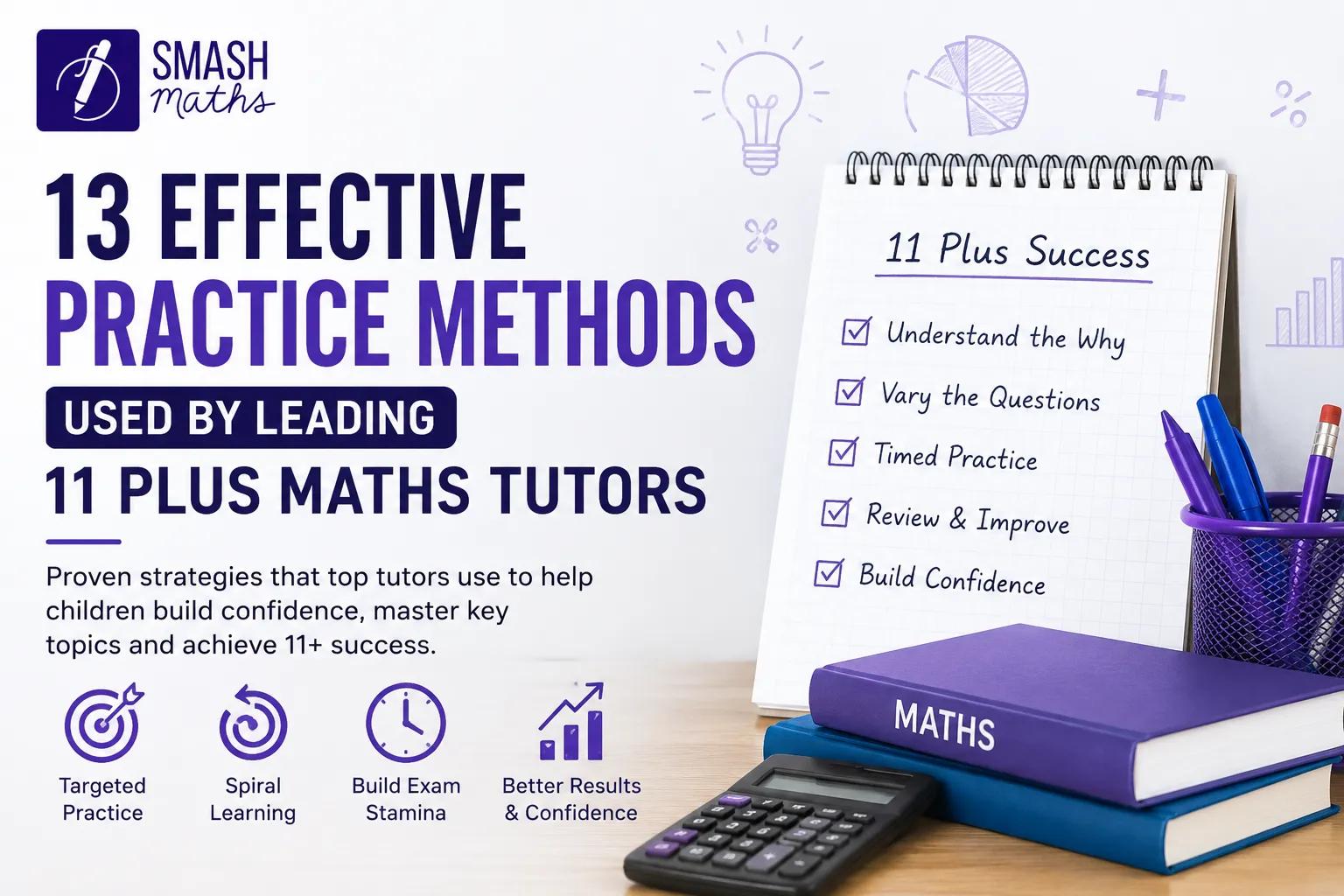
Most parents assume the children who pass the 11 Plus are simply the cleverest ones in the room. That's not really true. According to GL Assessment, the UK's leading 11+ test provider, the children who perform best are almost always the ones who've been prepared differently, not just more. If you're searching for 11 plus tutors online in the UK and wondering what separates a genuinely effective tutor from one who just assigns practice papers, you're asking exactly the right question. This is the answer.
Why Does Practice Method Matter So Much?
Here's the thing, most people don't realise until they're knee-deep in preparation.
Doing more practice papers doesn't automatically mean better results. It means better results if the child understands why they got things wrong, revisits those areas consistently, and builds genuine exam habits alongside content knowledge.
Without that? You get a child who's done forty practice papers and still misreads questions under pressure. Still forgets to write units. Still panics at reverse percentages.
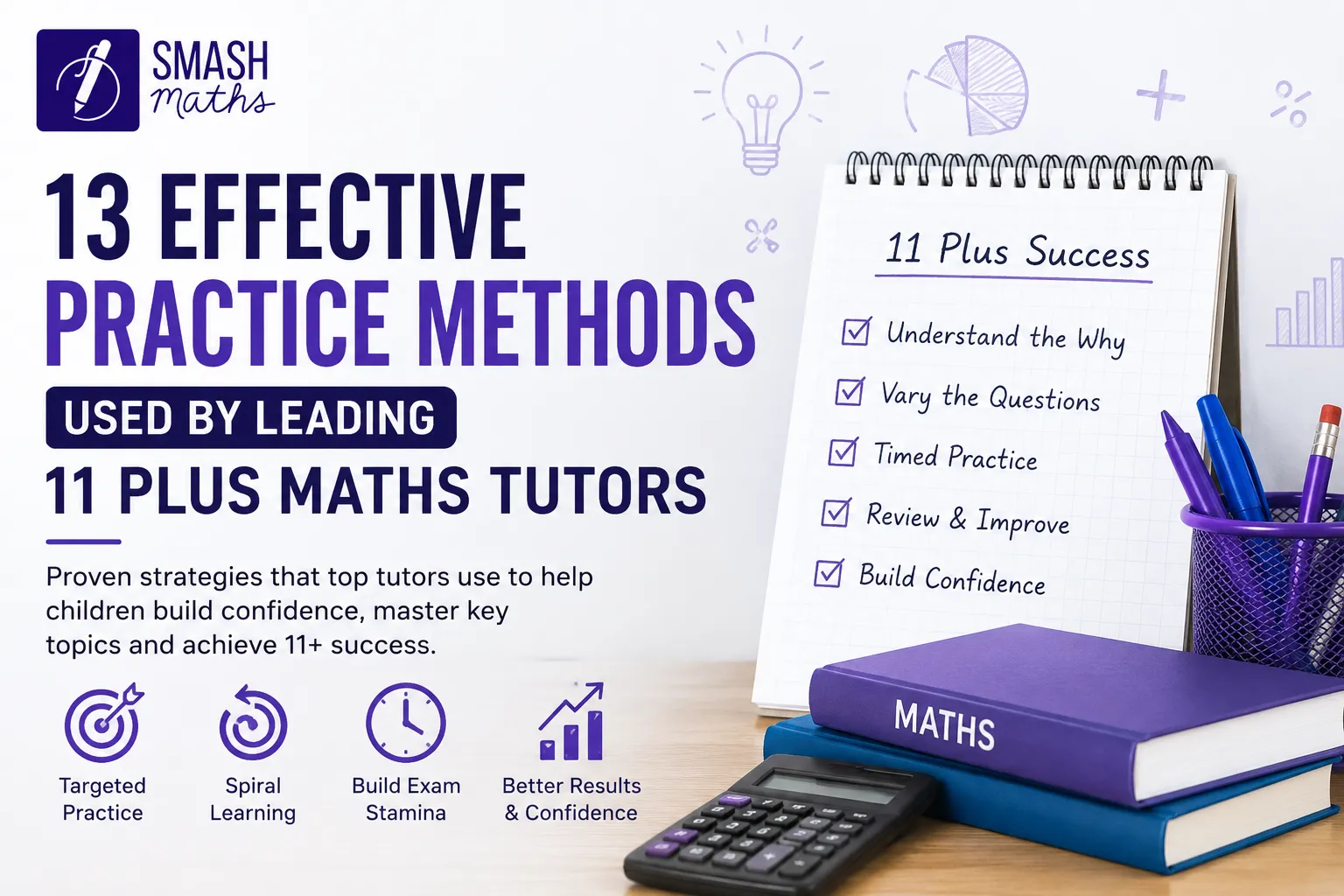
The method is everything. And the best tutors — the ones whose students actually get into grammar schools — all tend to use the same core approaches. Here are thirteen of them.
The 13 Practice Methods That Actually Work
1. Audit Before You Teach
The first thing any good tutor does — before a single practice question — is figure out exactly where the child currently is.
Not a rough guess. An actual diagnostic. Which topics are solid? Where are the gaps? Is the child a year behind on fractions but fine with algebra? Or the other way around?
Without this step, you're just teaching in the dark. The audit shapes everything that comes after.
2. Target the Gap, Not the Whole Curriculum
Once the gaps are mapped, good tutors don't work through the entire KS2 curriculum from start to finish. That wastes time a child doesn't have.
Instead, they prioritise. If fractions, percentages, and multi-step word problems account for the most lost marks — and they usually do — that's where the hours go first.
Think of it like a leaky boat. You don't repaint the hull. You find the holes and plug them.
3. Short Sessions, High Frequency
This one surprises a lot of parents. Twenty minutes, five days a week, beats a two-hour Sunday session every single time.
The brain retains information better through regular, spaced exposure than through occasional long bursts. This is backed by decades of cognitive science research — what's called the spacing effect, documented extensively by the American Psychological Association.
Good tutors build short, frequent sessions into a child's week rather than cramming preparation into one slot.
4. Use the Spiral Approach — Revisit, Don't Just Review
This is the method that separates genuinely effective preparation from the rest. And it's the foundation of how Smashmaths structures its entire programme.
The Spiral Curriculum — originally developed by psychologist Jerome Bruner — works on the principle that children don't master a topic the first time they see it. They master it through repeated exposure, each time at a slightly deeper level.
Instead of covering fractions in week two and moving on forever, the spiral approach brings fractions back in week five, week nine, week fourteen — in different question formats, combined with other concepts, at increasing difficulty.
If you want to see exactly how this plays out in practice, the tips from 11 plus maths tutor resources from Smashmaths go into real detail on how this looks session by session.
Think of it like a spiral staircase. Every floor, you pass the same window — but you're a little higher up, seeing a wider view. The content is familiar, but the understanding deepens.
5. Teach the "Why," Not Just the "How"
A child who has memorised the method for finding a percentage can do it — until the question looks slightly different. Then they're lost.
A child who understands why the method works can adapt it. They can apply the same logic to a question they've never seen before.
This is the difference between surface learning and deep learning. Good tutors never skip the "why."
6. Vary the Question Format Constantly
Children practise one type of question until they're confident. Then they see the same maths dressed differently and freeze.
"Find 30% of £80" and "a price is reduced by 30% to £56 — what was the original?" are both percentage questions. But they look completely different on paper.
Effective tutors deliberately vary the format of every topic — word problems, diagrams, multi-step questions, reverse problems — so children aren't thrown by unfamiliar presentation on the actual exam day.
7. Timed Mini-Sessions Before Full Papers
Most preparation goes straight from topic practice to full-time papers. That's too big a jump.
The step in between — ten questions in eight minutes, or fifteen questions in twelve minutes — builds exam stamina gradually. It gets children used to thinking under time pressure in small doses before the full pressure of a complete paper.
It also makes it easier to pinpoint which question types slow them down the most.
8. Underline Before Calculating — Every Time
This sounds almost too simple to be on a list like this. But ask any experienced tutor, and they'll tell you: the underlying habit alone recovers two to four marks per paper.
Before touching a calculator or writing a single number, the child underlines the key instruction word. Total. Difference. Remaining. Perimeter. Fraction of. It takes three seconds. It stops misreads before they happen.
Good tutors drill this until it's completely automatic — not just something children do when they remember.
9. Review Mistakes Longer Than You Take the Test
Here's a rule most parents don't apply: the review phase should take longer than the test itself.
Sitting a ten-question practice set in eight minutes, then moving on to the next one, is almost useless. You've just repeated the same errors faster.
Sitting a ten-question set, then spending fifteen minutes going through every wrong answer — why it went wrong, what the right approach was, and redoing it — that's where progress actually happens.
10. Build Checking Habits Into Every Session
End-of-paper checking isn't a separate skill. It has to be practised as part of every session, from day one.
Good tutors build in five minutes at the end of every timed task — not to change answers randomly, but to run a specific check: units correct? Calculation sensible? Question answered (not a related but different question)?
Children who've never practised checking have no idea what to check for. It's a skill in itself.
11. Work on Maths Anxiety Directly
This is the one most tutors don't talk about enough. Up to 20% of children experience maths anxiety severe enough to impair their performance, according to researchers at the University of Cambridge.
And here's the thing — anxious working memory is reduced working memory. A child who is panicking cannot access the same knowledge as a child who is calm and confident.
Effective tutors work on this deliberately. They structure sessions, so children experience regular small wins. They reduce the fear of being wrong by treating mistakes as useful information, not failures. They build confidence through exposure, not pressure.
12. Connect Maths to Real Life
Fractions are hard in the abstract. They make immediate sense when a child is working out how to split a pizza or calculating how much of a weekly pocket money amount they've already spent.
The best tutors bring maths into real contexts constantly. Shopping for percentages. Cooking for fractions. Journey times for mental arithmetic. It doesn't just make maths more engaging — it builds flexible thinking that transfers to unusual exam questions.
13. Track Progress Visibly
Children who can see their progress improve faster. This isn't just an anecdote — the Education Endowment Foundation consistently highlights visible feedback as one of the highest-impact strategies for learning.
Good tutors track not just overall scores, but topic-by-topic accuracy over time. A child who started at 40% accuracy on fractions and is now at 75% knows they're improving — and that knowledge keeps them going when preparation feels hard.
How These Methods Compare to Standard Preparation
Here's an honest side-by-side of what standard at-home preparation looks like versus what structured tuition with the right methods delivers:
Practice Approach | Mistake Reduction | Exam Technique | Confidence | Progress Visibility |
|---|---|---|---|---|
Practice papers only | Slow — errors repeat | Rarely addressed | Inconsistent | None |
Generic weekly tutor | Variable | Sometimes covered | Depends on rapport | Often informal |
Spiral-based programme | Fast — gaps caught early | Built in from day one | Grows through structured wins | Clear and consistent |
The difference isn't small. And it shows up on the day that matters.
What Does a Good Week of 11 Plus Maths Practice Actually Look Like?
Here's a realistic week — the kind an effective tutor would design:
Monday — 20-minute session on a specific weak topic (e.g. reverse percentages). Ten questions, timed loosely. Review every wrong answer in detail.
Tuesday — 15-minute mental maths warm-up. Times tables, quick-fire number bonds, estimation practice. No calculator.
Wednesday — Mixed topic mini-paper. 12 questions across three topics. Strict timing. Five-minute check at the end.
Thursday — Word problem focus. Five multi-step problems. Write the working out in full for each one.
Friday — Short review. Go back through any mistakes from the week. Redo the ones that went wrong. End on something the child is genuinely good at.
That's it. One hundred minutes across five days. Done consistently over four to six months, this kind of routine closes significant gaps.
Frequently Asked Questions
How do I know if my child's current tutor is using effective methods? Ask them. Specifically: do they track topic-by-topic progress? Do they revisit old topics regularly rather than always moving forward? Do they work on exam technique as well as content? If the answers are vague, that's useful information.
At what point should we start this kind of structured preparation? Year 4 for light, regular groundwork. Year 5 for full preparation ramp-up. Most grammar school tests in England happen in September or October of Year 6, so by the time that arrives, you want the foundation to already be solid.
My child hates maths. Will any of this actually work? Almost always, yes — but it depends on how the sessions are run. Children who hate maths have usually experienced failure too often without enough success. Short sessions, visible progress, and regular wins genuinely change the relationship a child has with the subject.
Is online tuition as effective as sitting in a room with someone? In most cases, yes — provided the programme is well-structured, and the child has a regular routine. Many families across the UK find online preparation more consistent than in-person tutoring because it's not dependent on travel, availability, or a fixed location.
What's the single biggest thing parents can do to help? Keep sessions short and regular, and resist the urge to overload at weekends. Consistent daily practice beats inconsistent marathon sessions every time.
Conclusion
There's no shortage of 11+ preparation resources in the UK. Practice papers, workbooks, YouTube videos — they're everywhere. And they all have value, used correctly.
But the reason some children walk out of the 11+ feeling composed and prepared, while others feel like they've been ambushed, isn't talent. It's a method.
The thirteen approaches in this list are what effective tutors actually do — the ones who get consistent results across different children, different regions, different starting points.
Smashmaths was built around these exact principles. The spiral curriculum ensures no topic is covered once and abandoned. The structured sessions build exam technique alongside content knowledge. And because it's fully online, families from Kent to Cheshire, Birmingham to Edinburgh, can access the same quality of preparation without rearranging their entire schedule.
If your child is heading for the 11 Plus, the method matters as much as the effort. Make sure both are in place.