


There's a version of SATs preparation that goes like this: buy a set of workbooks in January, work through them until May, hope for the best. Thousands of families across England do exactly this every year — and thousands are surprised when the results don't reflect how much work went in. According to Gov.uk national statistics, around one in four pupils in England does not meet the expected standard in KS2 maths — and in most cases, the gap isn't about ability. It's about how revision was structured. If you're researching year 6 SATs revision online in the UK and wondering what actually works, these twelve strategies are what the evidence — and experienced teachers — actually back.
Why Most SATs Revision Doesn't Work as Well as It Should
Before the strategies, it's worth being honest about the most common problem.
The typical family approach to SATs revision is well-intentioned but structurally flawed. A child sits with a workbook, works through questions, checks the answers at the back, and moves on. Nobody analyses why the wrong answers were wrong. Nobody ensures the weak topics get more time than the strong ones. Nobody builds the habits — reading questions carefully, showing working, checking — that determine performance on the actual papers.
Doing more of the same thing faster isn't preparation. It's repetition. And repetition without reflection rarely closes gaps.
The twelve strategies below change the approach — not the effort.
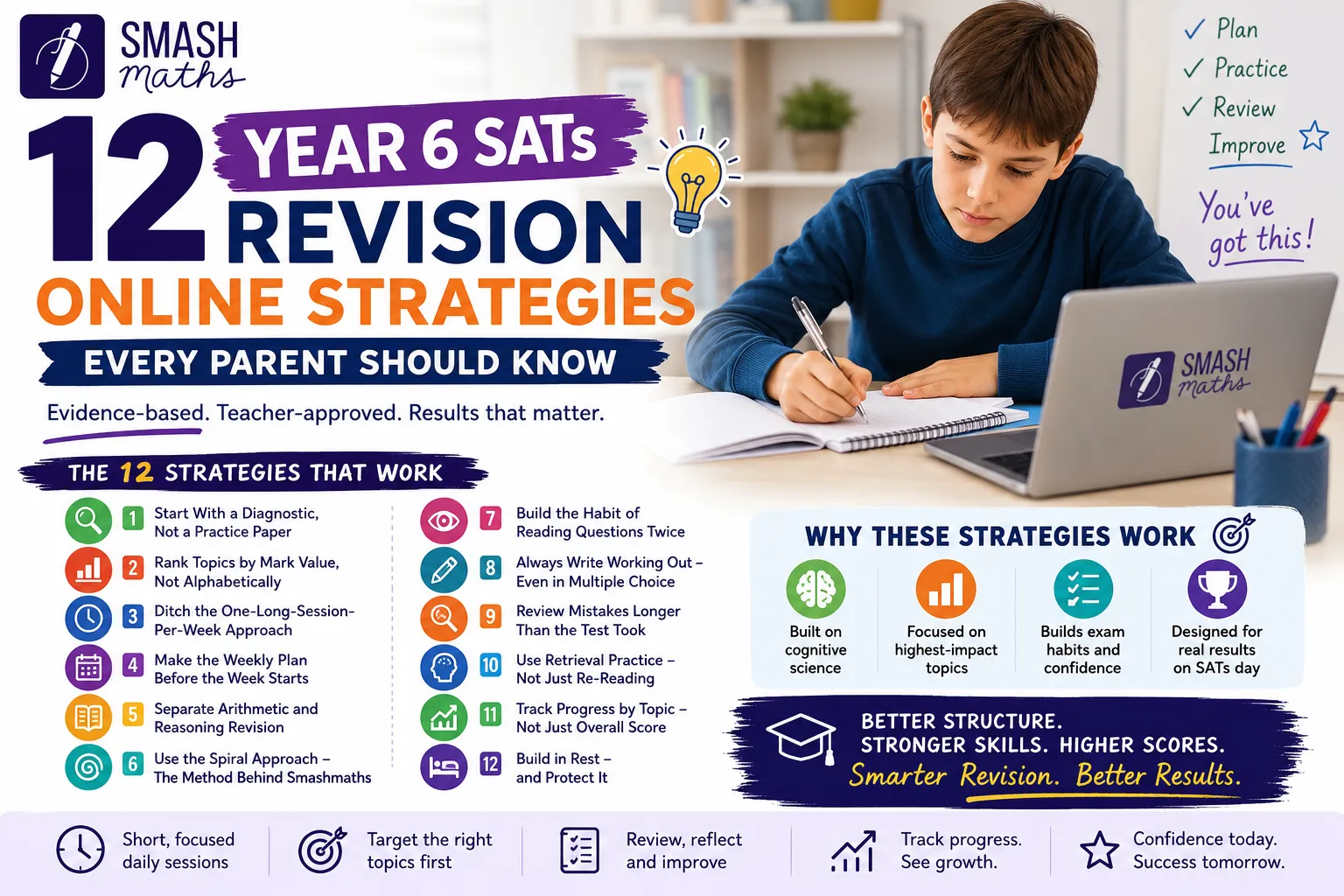
The 12 SATs Revision Strategies That Actually Move the Needle
1. Start With a Diagnostic — Not a Practice Paper
This is the most important thing on this list, and it's the one most families skip entirely.
A full practice paper at the start of revision tells you how a child performs under pressure on everything at once. What it doesn't tell you is why they're dropping marks in specific areas — or which areas are fixable in the time available.
A topic-by-topic diagnostic does. Go through the KS2 maths curriculum topic by topic. Identify which areas are solid, which are shaky, and which are genuinely not understood. That map shapes everything that follows.
2. Rank Topics by Mark Value, Not Alphabetically
Once you know the gaps, rank them by how many marks they're likely to save in the actual papers.
Based on Standards and Testing Agency past papers, the highest-value topics in KS2 maths SATs are consistently:
Fractions (adding, subtracting, multiplying, finding fractions of amounts)
Long multiplication and long division
Decimals and place value
Percentages of amounts
Multi-step word problems
Ratio and proportion
These should take the most time. Topics that appear rarely and carry fewer marks can be touched briefly and moved on from quickly.
3. Ditch the One-Long-Session-Per-Week Approach
This might be the single most evidence-backed change any family can make. The American Psychological Association has documented that spaced practice extensively — spreading revision across multiple short sessions over time — produces far stronger retention than the same amount of time spent in one block.
Twenty minutes of focused maths daily outperforms two hours every Saturday. Every time.
The brain retains information better when it's forced to retrieve it repeatedly, with gaps in between. One long session gives the impression of productivity. Daily short sessions actually build knowledge.
4. Make the Weekly Plan Before the Week Starts
Decision fatigue is real, and it kills SATs revision consistency more than anything else.
When parents and children have to decide each day what to revise, when to revise, and for how long — that decision-making process creates friction. Friction leads to avoidance. Avoidance leads to the session not happening.
Spend ten minutes every Sunday planning the coming week in writing. Monday: arithmetic — fractions. Tuesday: reasoning — word problems. Wednesday: mental maths and times tables. Written down. No daily negotiations.
5. Separate Arithmetic and Reasoning Revision
These are two different papers testing two different skills. They need separate, deliberate practice — not just "maths generally."
The arithmetic paper tests whether children can calculate accurately and quickly. The reasoning papers test whether they can apply maths to problems, often across multiple steps and in unfamiliar contexts.
Revising them together — or assuming one transfers automatically to the other — is a mistake. Arithmetic practice should be fast and timed. Reasoning practice should be careful, methodical, and focused on understanding the question before calculating.
6. Use the Spiral Approach — The Method Behind Smashmaths
This is the strategy that separates structured online SATs programmes from standard workbook revision — and it's backed by decades of educational research.
The Spiral Curriculum, developed by psychologist Jerome Bruner, works on a principle that's obvious once you hear it but rarely applied in practice: children don't master a topic the first time they see it. They master it through repeated return visits — each time in a slightly different context, at a slightly deeper level.
At Smashmaths, the entire SATs revision programme is built this way. Fractions don't appear in week two and disappear. They come back in week five (with decimals), week nine (in word problems), week thirteen (in the context of ratio). Each time the concept is more familiar. Each time the understanding goes a little deeper.
Think of it like learning to drive. First lesson: controls and basic movement. Second lesson: controls plus simple junctions. Sixth lesson: all of that plus dual carriageways. Nobody learns everything in one sitting — and the things covered first keep getting reinforced as the new things are added. The spiral works the same way.
7. Build the Habit of Reading Questions Twice
This habit is worth two to four marks per paper. Conservatively.
Children rush. They see a number problem, assume they know what's being asked, and calculate before properly reading the question. They find the total when the question asks for the difference. They calculate the area when perimeter is needed.
The fix is simple but requires repetition to become automatic: underline the key instruction word before doing any calculation. Remaining. Difference. Perimeter. Fraction of. How many more. Three seconds. Every question. Without exception.
Practise this in every revision session — not just on practice papers — until it's a reflex.
8. Always Write Working Out — Even in Multiple Choice
Children doing multiple-choice papers often think working out is optional. It isn't — not because examiners check it, but because two lines of jotted working catch errors before they're committed as final answers.
For standard answer format papers, missing working can cost marks directly. The habit to build: every multi-step question gets written working. Not optional. Not only when the question says "show your method." Always.
9. Review Mistakes Longer Than the Test Took
Here's the rule most families break: the review should take longer than the test.
Sitting a ten-question practice set in eight minutes, marking it, and moving on to the next one produces almost no learning. You've just confirmed what you already knew.
Sitting a ten-question set, then spending fifteen minutes on every wrong answer — why did it go wrong, what was the right approach, can I now do it correctly — that's where the actual improvement happens.
Mistakes are the most valuable information in revision. Treat them that way.
10. Use Retrieval Practice — Not Just Re-Reading
There's a well-established difference between reviewing material and actively retrieving it. Reviewing — looking at worked examples, reading through notes — feels productive. Retrieval — trying to recall or apply something without looking at it first — is uncomfortable but far more effective.
The Education Endowment Foundation consistently rates retrieval practice as one of the highest-impact, lowest-cost strategies in education.
In practice: close the book. Try the question from memory. Then check. Then try a similar one. That sequence produces far stronger retention than reviewing first and then practising.
11. Track Progress by Topic — Not Just Overall Score
Overall test scores go up and down based on which topics happened to appear that week. They're not a reliable measure of progress.
Topic-level tracking is. A simple table — fractions, long multiplication, percentages, multi-step problems — with accuracy noted each week gives you real information. It shows a child that their fractions accuracy went from 35% in week two to 80% in week eight. That specific, concrete evidence of progress is genuinely motivating in a way that overall scores rarely are.
It also tells you where to focus the following week — which is more useful than guessing.
12. Build in Rest — and Protect It
This is the strategy most families treat as a luxury. It isn't.
A child who is consistently overtired retains less information, makes more errors, and is more anxious — all of which directly reduce SATs performance. The NHS recommends 9–11 hours of sleep per night for primary-school-age children. In the weeks before SATs, that recommendation matters more, not less.
Planned rest days — evenings off, Saturday afternoons free, activities that have nothing to do with school — are not wasted revision time. They're recovery time that makes the next revision session more effective.
What a Well-Structured Revision Week Actually Looks Like
Here's a concrete example — a realistic week that applies most of these strategies without taking over family life:
Day | Focus | Format | Time |
|---|---|---|---|
Monday | Fractions — of amounts and equivalents | 10 retrieval questions, review all wrong answers | 20 mins |
Tuesday | Arithmetic — long multiplication and division | Timed: 8 questions in 6 minutes | 20 mins |
Wednesday | Reasoning — multi-step word problems | 5 questions, write working for each | 20 mins |
Thursday | Percentages and decimals | Mix of retrieval and new practice | 20 mins |
Friday | Times tables + mental arithmetic warm-up | Rapid recall, no written working | 15 mins |
Saturday | One full practice paper (one section only) + full review | Timed, then reviewed thoroughly | 45–60 mins |
Sunday | Rest — plan next week's sessions | 10 mins planning only | 10 mins |
That's roughly two hours of revision across the week. Structured, specific, and sustainable — not a burden that takes over the household.
How Online SATs Revision Compares to Other Approaches
Revision Method | Adapts to Weak Areas | Tracks Topic Progress | Builds Exam Habits | Fits Family Schedule |
|---|---|---|---|---|
Workbooks at home | No — same for everyone | No | Rarely | Yes but unstructured |
School revision sessions | Partially — class-based | Limited | Some | No — fixed school time |
Generic revision websites | Rarely | Rarely | No | Yes |
Private weekly tutor | Depends on tutor | Informal | Sometimes | Difficult — fixed slot |
Smashmaths Online SATs Programme | Yes — spiral and targeted | Yes — topic by topic | Built into every session | Yes — fully flexible |
Conclusion
There's nothing mysterious about what makes SATs revision effective. Short, frequent, specific practice. Topics prioritised by mark value. Mistakes reviewed properly. Progress tracked at the topic level. Exam habits built deliberately. Rest protected.
That's it. That's the difference between revision that feels like a lot of effort and revision that actually produces results.
Smashmaths was built to deliver all of this in one place — online, flexible, and structured around the spiral approach that makes topics stick rather than fade. The programme tracks topic-level progress, builds arithmetic and reasoning skills in parallel, and creates the exam habits that children need to perform at their actual level on the day.
If your child is heading towards SATs and revision isn't feeling organised yet, now is the time to change that. Not with more workbooks. With a better structure.